
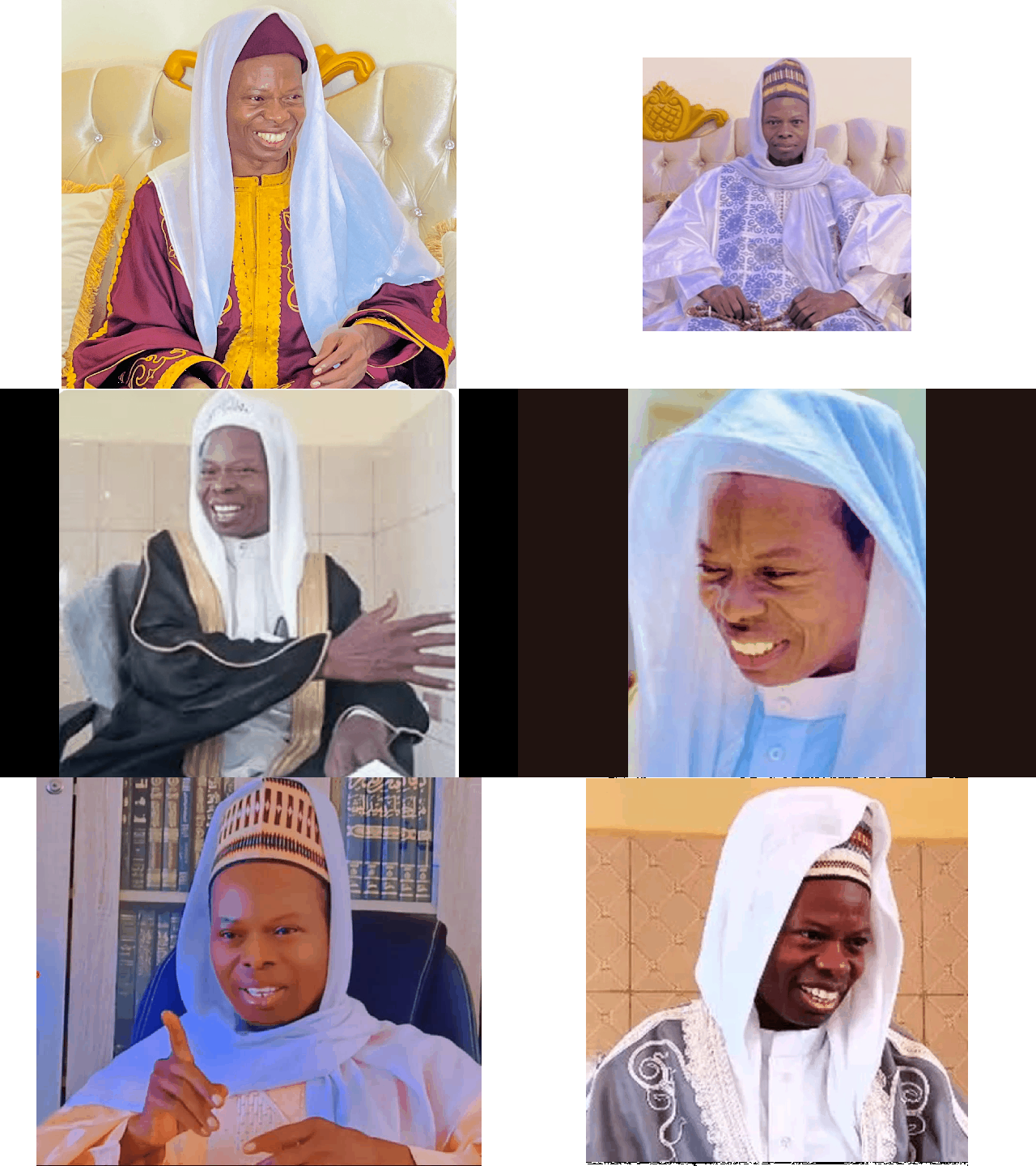

The Tijaniyya Order in the Middle East
As for the Tijaniyya order in the East—such as China, Singapore, Indonesia, Malaysia, and India—it spread widely thanks to the efforts of its sheikhs, including Sheikh Muhammad al-Mahi Cissé, Sheikh Sharif Ibrahim Salih al-Husseini, Sheikh Ahmad al-Hadi al-Husseini, Sheikh Dr. ‘Umar Mas‘ud, and others. Tijani zawiyas are present in these regions. Among those who played a major role in spreading the order, especially in Malaysia, is Sheikh Ahmad al-Hadi al-Husseini al-Tunisi al-Ba‘qili. Sheikh Muhammad al-Mahi Cissé had an extraordinary role in spreading the order in Singapore, Indonesia, and surrounding areas, appointing representatives (muqaddams) in those countries to transmit the path. All praise and thanks are due to Allah.
Among the representatives of the order in Kuwait is Sheikh ‘Abd al-Rahman al-‘Awadhi, who was very active there.
Among the prominent Tijani scholars in Iraq was the righteous saint and scholar Sheikh ‘Ali al-Hanuti (may Allah have mercy on him), who served as an imam and preacher in many mosques in Baghdad and possibly in other Iraqi provinces. Some of his successors also served as imams, being people of knowledge and adherence to the Sharia. Also among them is the gnostic Sheikh Muhammad Asif, son of the scholar and jurist Sheikh Mustafa Aal Taha. His father (may Allah have mercy on him) was a scholar and jurist of the Shafi‘i school. Sheikh Muhammad Asif himself possessed knowledge and understanding of Islamic law, in addition to his academic education and his position as a director in a government department. He entered the Tijaniyya after a vision he saw in a dream, through the hand of the gnostic Sheikh Muhammad al-Hafiz al-Husseini al-Tijani of Egypt.
In Palestine, both common people and scholars joined the Tijaniyya order, including the mujahid Sheikh ‘Izz al-Din al-Qassam, Sayyid Ahmad al-Dadasi, and Sayyid ‘Ali al-Daqar. Among the most famous Tijani scholars in Jordan is the Grand Mufti, Sheikh Nuh al-Qudah.
In Mecca and Medina, the Tijaniyya also spread. It is mentioned in the book “Adwa’ ‘ala al-Shaykh al-Tijani wa Atba‘ihi” (p. 243) that among the representatives residing in Medina were al-Hajj Muhammad ‘Abd al-Malik al-‘Alami, his brother the scholar al-Laqqani, and their descendants who still remain there, as well as Sayyid Muhammad Alfa Hashim, Sheikh Ibrahim al-Susi, al-Hajj Ibrahim al-Sudani, and al-Hajj Mustafa al-‘Alawi, author of “Unwan al-Najaba fi Man Dufuna bi al-Madinah al-Munawwarah.”
It is also mentioned (p. 269) that Sheikh Muhammad ‘Abd al-Malik al-Sa’ihi established the first Tijani zawiya in Medina. On page 297, it is stated that in that same year, Sheikh ‘Abd al-Malik negotiated with Sheikh Alfa Hashim regarding the zawiya in Medina.
Among the leading scholars of the Tijaniyya in Saudi Arabia is the gnostic Sidi Muhammad al-Ghali ibn Muhammad Fatha ibn Idris ibn Abi Talib al-Hasani al-Idrisi, a descendant of al-Qasim ibn Mawlay Idris al-Azhari. He moved with his family to the Two Holy Sanctuaries. Among his well-known disciples is Sheikh ‘Umar al-Futi, who received the Tijani path from him in Medina.
Sheikh Muhammad al-Ghali passed away in Mecca during the month of Dhu al-Hijjah in the year 1244 AH and was buried in al-Ma‘la cemetery beside the grave of our Lady Khadija al-Kubra (may Allah be pleased with her).
Also among the prominent Tijani scholars in Saudi Arabia is Sheikh Muhammad Hashim ibn Ahmad al-Futi al-Maliki al-Madani, known as Alfa Hashim Tal. He was born in 1283 AH in the town of Halwar in northern Senegal, in a Fulani region of the Sahara in Africa.
When the French invaded his homeland in 1320 AH, he initially resisted them but was eventually forced to leave his country. He traveled to the Hijaz to perform Hajj, at a time when journeys were extremely difficult—either on foot or by riding animals. He arrived in Mecca in 1322 AH, performed the pilgrimage, and met a group of scholars who honored him and recognized his knowledge. Allah then granted him the opportunity to visit the Prophet ﷺ. He later returned to Mecca and began teaching in the Sacred Mosque until the end of 1326 AH, after which he moved to Medina, where he settled and became well known among its people and students.
Leave a Reply