
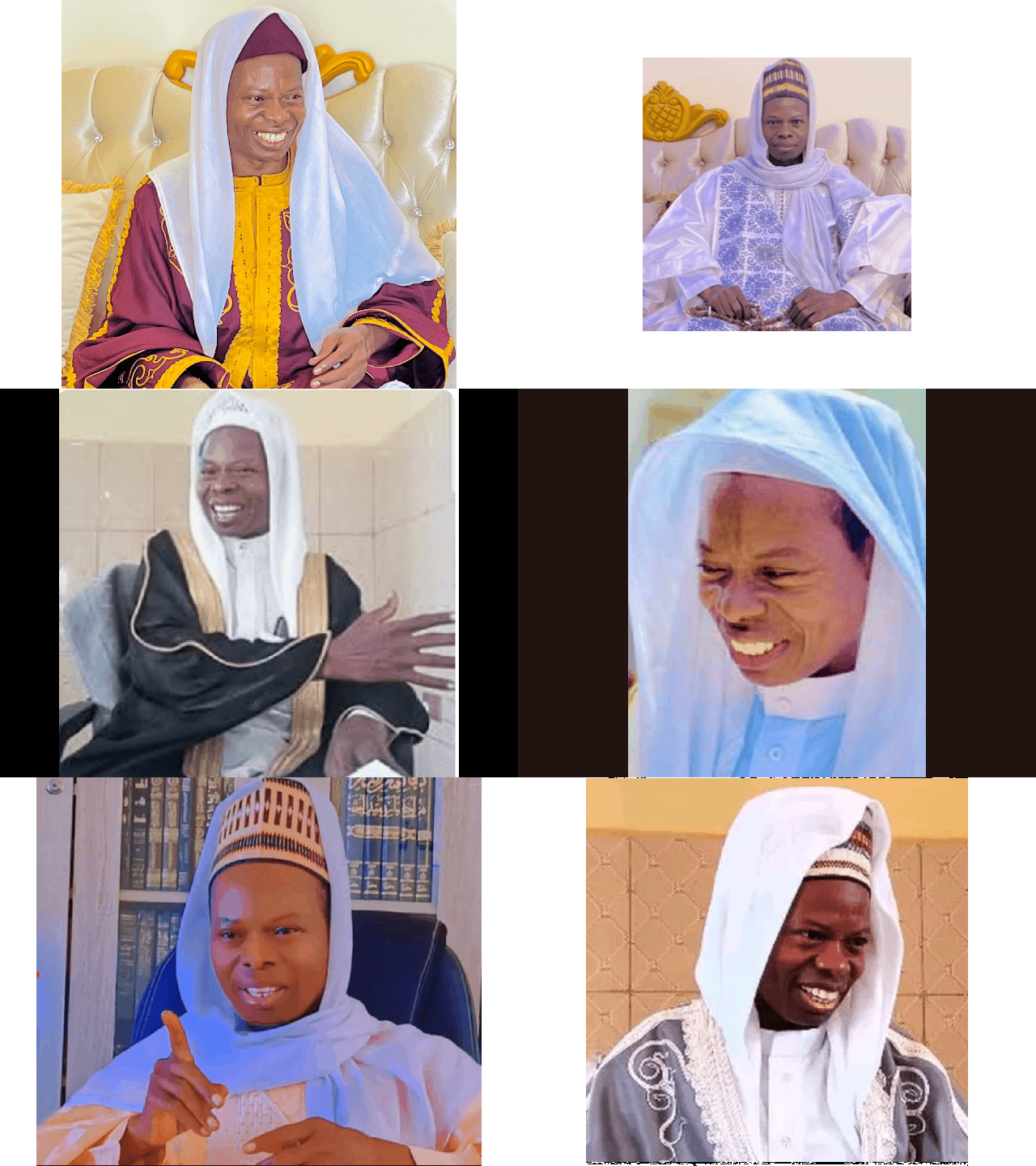

The Tijaniyya Order Around the World
The original homeland of the Tijaniyya order is Algeria. It later moved to Morocco—specifically to the city of Fez—where it was embraced by scholars and rulers. The founder of the order, Sheikh Sidi Ahmad al-Tijani (may Allah be pleased with him), was born in ‘Ayn Madi, now التابعة to Laghouat Province in Algeria, in the year 1150 AH.
The order began to spread in his birthplace, ‘Ayn Madi, among his family and relatives. From there, its influence expanded across many regions of the Algerian Sahara, and eventually throughout the rest of Algeria.
It is difficult for any writer to enumerate all the men who contributed to spreading the teachings of the order in Algeria. Among them were the eminent scholar Sidi Muhammad al-Habib and Sidi Muhammad al-Kabir, sons of Sheikh Sidi Ahmad al-Tijani, as well as Sidi Ahmad ‘Ammar ibn Sidi Muhammad al-Habib (may Allah be pleased with them). They played a major role in carrying the banner of the order and preserving the unity of the الأمة (Muslim community). Also among them was the grandson of Sheikh Sidi Ahmad al-Tijani, Sidi al-Hajj ibn ‘Umar al-Tijani of Algeria.
Among them was also the قطب (spiritual pole) and خليفة (successor), Sidi al-Hajj ‘Ali al-Tamassini, a man of action who left behind immense wealth for his zawiya, including fourteen thousand palm trees. He also left many disciples and men who carried the banner of the order, including the current khalifa, Sidi Muhammad al-‘Aid (may Allah be pleased with him).
Also among them was the great scholar Sidi al-Hajj ‘Ali Harazim, who documented the teachings and knowledge of the Sheikh in the reference work “Jawahir al-Ma‘ani.” He also played a major role in spiritual التربية (education) in regions such as Tunisia, Egypt, and the Hijaz.
Among the distinguished scholars were Sheikh Muhammad Aknasous, Sheikh Ahmad Sukayrij, and Sheikh Idris al-‘Iraqi, author of numerous works. In Tunisia, there was Sheikh Sidi Ibrahim al-Riyahi (may Allah be pleased with him). In Egypt, Libya, Sudan, Palestine, the Levant, the Hijaz, and across Africa, the order spread widely.
Among the Egyptian sheikhs was Sheikh Muhammad al-Hafiz al-Misri, who possessed qualities that made him a true scholar and spiritual guide. He left behind many righteous men and disciples across the world. He also authored several works, including the magazine “Tariq al-Haqq.” In Sudan, the Tijani followers play a major role in preserving Islamic principles, including figures such as Sidi Muhammad ibn al-Mukhtar and the Maliki jurist, Sayyid Muhammad al-Mustafa al-‘Alawi.
As for the Hijaz, it is mentioned in the book “Adwa’ ‘ala al-Shaykh al-Tijani wa Atba‘ihi” (p. 243) that among the representatives residing in Medina were al-Hajj Muhammad ‘Abd al-Malik al-‘Alami, his brother the scholar al-Laqqani, and their descendants who still remain there, as well as Sayyid Muhammad Alfa Hashim, Sheikh Ibrahim al-Susi, al-Hajj Ibrahim al-Sudani, and al-Hajj Mustafa al-‘Alawi, author of “Unwan al-Najaba fi Man Dufuna bi al-Madinah al-Munawwarah.” It is also stated (p. 269) that Sheikh Muhammad ‘Abd al-Malik al-Sa’ihi founded the first Tijani zawiya in Medina, and (p. 297) that he negotiated with Sheikh Alfa Hashim regarding the zawiya.
Among the prominent scholars of the Tijaniyya in Saudi Arabia is the gnostic (‘arif بالله) الشريف الأصيل Sidi Muhammad al-Ghali ibn Muhammad Fatha ibn Idris ibn Abi Talib al-Hasani al-Idrisi.
The order is also present in Bahrain, Kuwait, the UAE, Afghanistan, Pakistan, Iran, Iraq, and Turkey.
It extended to Europe, where Sheikh Ahmad Mansur succeeded in spreading its influence in France. By 1945, Paris alone had fourteen zawiyas. Since 1970, Tijani migrants established a zawiya in the suburbs of Ivry. ‘Abd al-Samad ‘Abd al-Wahid also introduced the order into Italy, after which it spread to England, Albania, and the Balkans.
In the Levant and Palestine, both common people and scholars joined the Tijaniyya, including the mujahid Sheikh ‘Izz al-Din al-Qassam, Sayyid Ahmad al-Dadasi, and Sayyid ‘Ali al-Daqar. Among the notable figures in Jordan is the Grand Mufti, Sheikh Nuh al-Qudah.
Across Africa, there is no dispute that the largest center of the Tijaniyya worldwide is on this continent. Countries with significant Tijani presence include Nigeria, Senegal, Ghana, Mali, Niger, Burkina Faso, Côte d’Ivoire, Sierra Leone, Gambia, Liberia, Togo, and Benin.
Among the prominent Nigerian sheikhs today are Sheikh Ibrahim Salih al-Husseini, Sheikh Tahir Uthman Buthi, and Khalifa Muhammad Sanusi, among many others too numerous to count. In Senegal, the family of Sheikh Ibrahim Niasse is widely renowned. In Ghana, there are Sheikh ‘Abdullah Mi Kano and Sheikh Uthman Sharubutu. In Mali, the families of Sheikh Ahmad Hamahullah and Sheikh Ibrahim Yaro are well known, including Sheikh Muhammad al-Mahi al-Sharif and Sheikh Mansur. In Niger, Sheikh Abu Bakr Jouti and Sheikh Shu‘ayb Yami are among the most famous. In Burkina Faso, Sheikh Abubakar Maiga and Sheikh al-Hajj Ya‘qub Wahyugiya and their كبار students are notable. In Côte d’Ivoire, the family of Sheikh Sharif ‘Abd al-‘Aziz is prominent.
In Sierra Leone, there is Sheikh Ahmad al-Tunisi, and in Liberia, Sheikh al-Hajj Muhammad Alfa Hashim.
In the East—such as China, Singapore, Indonesia, Malaysia, and India—the Tijaniyya spread widely thanks to the efforts of its sheikhs, including Sheikh Muhammad al-Mahi Cisse, Sheikh Ibrahim Salih al-Husseini, Sheikh Ahmad al-Hadi al-Husseini, and Dr. ‘Umar Mas‘ud. There are many Tijani zawiyas in these regions. Sheikh Ahmad al-Hadi al-Husseini al-Tunisi al-Ba‘qili played a major role in Malaysia, while Sheikh Muhammad al-Mahi Cisse had an extraordinary role in spreading the order in Singapore and Indonesia, appointing representatives there to teach the path.
In the United States, it is mentioned in the book “Islamic Sufism in the United States of America” by Dr. ‘Uzayr al-Kubayti (Vol. 2, p. 210) that the Tijaniyya has taken a leading place in academic research in America. On page 215, he notes that among their characteristics is unity despite their large numbers, and that their name remains unchanged. They are active in الدعوة (Islamic outreach), representing about 80% among African Muslims and 20% among native Muslims.
Imam Hasan Cisse (may Allah have mercy on him) said at a forum held in Morocco in 2008:
“And as for us, speaking of Allah’s blessings—as He says: ‘And proclaim the favor of your Lord’—I have introduced the Tijaniyya order into America and across its states: New York, Washington, Atlanta, Chicago, Detroit, California, Memphis, Tennessee, even to Bermuda and Trinidad, as well as South Africa in Johannesburg, Durban, and Cape Town. Zawiyas have spread in all these places, praise be to Allah at the beginning and the end.”
Among the well-known sheikhs in America today is Sheikh Ahmad al-Tijani ibn ‘Umar.
It is estimated that followers of the Tijaniyya order constitute nearly one-third of Muslims worldwide.
Tijaniya in countries of the world with video
Tijaniya in China with video
Tijaniya in Saudi Arabia with video
Tijaniya in London video
Tijaniya in America video
Tijaniya in Singapore video
Tijaniya in India with video
We have videos of the method from all over the world, not all of them can be uploaded here. As for the African ones, most of them are Tajani. I am an African, I know Africa.
https://share.google/eIytntLzxNzSZW0yH
Leave a Reply